

AI agents are becoming a new front door to travel. The businesses with structured, verified data will be the ones they recommend.
Nomads.com, the city database for remote workers and digital nomads, has launched a paid API. The bigger story is who it is built for. Levels said on X it is primarily for AI agents, with an MCP server alongside it, and only secondly for companies building apps. The API page itself lists AI agents as one of six use cases.
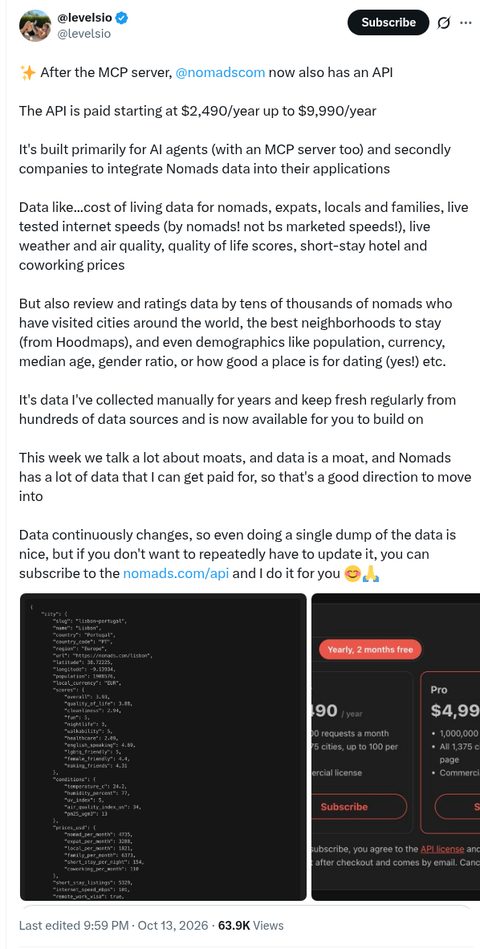
“After the MCP server, @nomadscom now also has an API. The API is paid starting at $2,490/year up to $9,990/year. It’s built primarily for AI agents (with an MCP server too) and secondly companies to integrate Nomads data into their applications.” Pieter Levels (@levelsio)
For anyone in travel, that order matters. A traveller who once Googled “best neighbourhood in Lisbon for remote work” may now just ask an assistant to plan the month. That assistant will not read your brochure or scroll your homepage. It will query data, and it will favour sources it can trust.
Check how visible your site is to AI agents with our free AI-ready scan.
Key takeaways
- Nomads.com launched a paid API that Levels described as “primarily for AI agents”, priced from $2,490 to $9,990 a year, covering 1,375 cities with 132 data fields each.
- Agentic travel means AI assistants research, compare and increasingly book trips for travellers, using structured data rather than websites.
- Verified data beats marketing claims: agents can check “fast WiFi” against tested speeds automatically.
- Travel businesses need machine-readable, measurable facts (schema markup, feeds, APIs or MCP servers) to be recommended by AI agents.
- A seven-question checklist below helps DMOs, hotels and tour operators check their readiness.
What is agentic travel?
Agentic travel is trip research, planning and booking carried out by AI agents on a traveller’s behalf. Instead of searching and clicking through websites, the traveller describes what they want. The agent queries data sources, compares options and returns a shortlist, or completes the booking.
Agents connect to those data sources through APIs and, increasingly, through MCP (Model Context Protocol) servers: a standard way for AI assistants such as Claude and ChatGPT to use outside tools and data.
What did Nomads.com launch?
The Nomads.com API sells structured data on 1,375 cities in 207 countries, with 132 fields per city, rebuilt hourly. It is offered as a REST API and as an MCP server, so AI agents can plug it in directly as a tool. The same API key works as an MCP connector at nomads.com/mcp.
The Nomads.com API costs $2,490 to $9,990 a year and covers 1,375 cities in 207 countries with 132 fields per city, updated hourly.
| Plan | Price per year | Requests per month | Max cities per page |
|---|---|---|---|
| Starter | $2,490 | 250,000 | 100 |
| Pro | $4,990 | 1,000,000 | 500 |
| Business | $9,990 | 5,000,000 | No limit |
Each field returned counts as 1 request, so a full city costs 131.
The data covers much more than cost of living:
- Costs for nomads, expats, locals and families, plus short-stay rental and coworking prices
- Conditions: live weather, air quality and median internet speeds (Nomads.com says members test these)
- Scores for quality of life, cleanliness, nightlife, walkability, healthcare, English, and LGBTQ+ and female friendliness
- Community data: member reviews and ratings, and meetups (the Nomads.com site also links to Hoodmaps for neighbourhoods)
- Demographics: population, currency, median age, even how good a city is for dating
The licence is commercial but tightly scoped. Responses can be cached for 30 days, but the raw data cannot be resold or used to build a rival city database. The value is in the ongoing feed, not a one-off download.
How AI agents change travel marketing: from SEO to agent optimisation
For 20 years, travel marketing has meant one thing: rank on Google, then convert the visit. AI agents skip the visit.
When someone asks an assistant to “find me a warm, affordable city with fast internet for February”, the agent pulls structured data from tools it trusts and returns a shortlist. The traveller may never see a destination website, a hotel homepage or an OTA results page. It is the next step beyond the zero-click search shift tourism brands are already dealing with.
That creates a new visibility problem. You can rank first on Google and still be invisible to an AI agent if your facts live in PDFs, images or vague copy. That happens when:
- your key facts sit in PDFs, images or marketing copy instead of structured data
- you have no API, feed or MCP endpoint an agent can query
- third-party data about you contradicts what you claim
Nomads.com is not alone. On 2 August 2026, Nomad Stays launched an MCP connector that lets assistants like Claude and ChatGPT search its listings, check availability and book stays inside a chat.
Both have moved early, packaging their data in the format agents use. Travel brands that wait will be summarised by someone else’s database.
Why verified data beats marketed data
The most quotable part of the launch was the founder’s jab about internet speeds being tested by nomads rather than marketed. It points to one of travel’s oldest problems: the gap between what suppliers claim and what travellers experience.
“Fast WiFi.” “Vibrant nightlife.” “Walkable centre.” Every listing says these things. Until recently, checking them meant reading dozens of reviews by hand.
Agents change that. An agent can compare a hotel’s “high-speed internet” claim with speed tests from people who stayed nearby, in seconds, every time. When they disagree, the agent will usually trust the measured number.
The takeaway for travel businesses: your marketing copy is about to be fact-checked automatically. Brands that publish honest, specific, measurable facts (real Mbps, real walking times, real prices) will gain trust. Vague superlatives will be filtered out, or flagged.
What travellers actually filter on now
Look at the fields Nomads.com thinks are worth paying for. Very few appear in a typical destination guide or hotel listing:
| What travellers ask | What most travel content provides |
|---|---|
| Tested internet speed | “Free WiFi” |
| Coworking and monthly living costs | Nightly room rate |
| Air quality and monthly climate | “Sunny all year” |
| Female, LGBTQ+ and family friendliness | Generic safety advice |
| Ease of making friends, community, meetups | Attractions list |
| Neighbourhood-level detail | City-wide overview |
Remote workers, long-stay travellers and “workcationers” choose places on liveability, not sightseeing. Agents serving them want machine-readable facts like these. Our Da Nang digital nomad guide is built around exactly these questions. Agents serving these travellers will look for the left-hand column. DMOs, serviced apartments, hotels and coworking spaces that publish those facts clearly have an open goal.
Your data is your moat
The founder put it plainly: data is a moat, and Nomads has plenty of it to charge for. It took years of manual collection from hundreds of sources, and it goes stale fast. Both make it hard to copy.
Most travel businesses are sitting on similar assets without seeing them that way:
- Tour operators: real group sizes, on-time rates, guest satisfaction by season
- Hotels and serviced apartments: measured WiFi speeds, noise levels, true walking times
- DMOs: visitor sentiment, event calendars, neighbourhood-level insight
- Travel creators and communities: years of first-hand, dated, local knowledge
Not everyone should launch a $10,000 API. But structured, verified, regularly updated data now does two jobs: it makes you visible to agents, and it may become a revenue line of its own.
Ways to make your data agent-ready
There are five common ways to publish facts AI agents can use. They build on each other: most travel businesses should start with schema markup and add the rest only when there is demand.
| Method | What it is | Effort | Typical cost | Who it suits | Example |
|---|---|---|---|---|---|
| Schema markup | schema.org JSON-LD in your pages describing your business, rooms, tours, prices and FAQs | Low | Staff or agency time; no new infrastructure | Every hotel, tour operator, attraction and DMO | Hotel, LodgingBusiness, TouristTrip, FAQPage |
| Public data feed | A regularly updated file (CSV, JSON or XML) of rates, availability or events | Medium | Often exported from an existing booking engine or CMS | Hotels with a channel manager, DMOs with event calendars | Google Hotels price feed, an events JSON file |
| llms.txt | A plain-text Markdown file at your site root pointing AI tools to your key pages | Low | Minimal; one file. It is a proposed convention, not an official standard | Any site with clear, citable pages | njoy.consulting/llms.txt, nomads.com/llms.txt |
| REST API | Endpoints that return structured data on request, usually with keys and rate limits | High | Developer build plus hosting and maintenance | Data owners, booking platforms, larger groups and DMOs | Nomads.com API |
| MCP server | A Model Context Protocol endpoint AI assistants connect to as a tool, often wrapping an API | High | Developer build on top of an API or database | Platforms that want to be queried or booked inside AI assistants | nomads.com/mcp, Nomad Stays connector |
The protocol itself is documented at modelcontextprotocol.io.
The caveats worth raising
Five caveats:
- Sample bias. Scores from nomads reflect nomads. The API sells cost data for families, but a city rated 5/5 for fun by remote workers may not suit a family of four or a retiree.
- Subjectivity. What does “fun: 5” or “making friends: 4.31” actually measure? Precise-looking decimals can hide very soft inputs.
- Sensitive fields. Gender ratios and dating scores are popular, but they raise ethical questions about how places and people are described.
- Concentration. If a handful of databases feed most AI agents, a few curators end up shaping how whole cities are presented to millions of travellers.
- No guarantees. The data comes “as is”, without warranty. That is normal for an API, but check before you rely on it.
Travellers are not handing over the booking yet either. In a YouGov survey of more than 5,700 adults in the US, UK and India for Expedia Group (March 2026), 53% were comfortable letting AI suggest travel options, but 66% said they would not trust AI to book on their behalf. Discovery is moving first.
None of this cancels the trend. It means the industry needs to supply its own trustworthy data rather than leave the field to others.
We tested it: what AI assistants recommend today
| # | Prompt | Engine A (OpenAI gpt-4.1 + web search): businesses named | Engine A: sources cited | Engine B (AI web search summary): businesses named | Engine B: sources cited | Named by both |
|---|---|---|---|---|---|---|
| 1 | Best coworking-friendly hotel in Lisbon with fast WiFi for a remote worker staying 2 weeks | Locke de Santa Joana (top pick), Martinhal Lisbon Chiado, Martinhal Lisbon Oriente, EVOLUTION Lisboa, EPIC SANA Marquês, Altis Grand, Four Seasons Ritz, Radisson Blu, Myriad, The Homeboat Company | aluri.app (2 pages), staygenie.app, pierreblake.com, navid.me | EVOLUTION Lisboa (top pick), EVOLUTION Valbom | sanahotels.com (5 pages, all the hotel group’s own site) | EVOLUTION Lisboa |
| 2 | Nomad-friendly apartment in Bali under $1000 a month with reliable internet | Dojo Coliving, Tribal Bali, Hubud Coliving, Livit Hub, Tropical Nomad, Outpost Coliving | nomadsinasia.com, aluri.app, baliapartmentsforrent.com (2), codnx.com | A Kuta studio on Citizen Remote ($672/mo, 300 Mbps, Starlink backup), a Canggu 1-bed on Bali Villa Hub, Sora Residence Sanur (300 Mbps) | citizenremote.com, balivillahub.com (3), soraresidencesanur.com | None |
| 3 | Best area and hotel in Da Nang for a digital nomad who needs fast WiFi for a month | Area: An Thuong / My An. Hotels: Hyatt Regency Danang, Pullman Danang Beach, Furama Resort, InterContinental Sun Peninsula, Premier Village, Naman Retreat, TIA Wellness | getnomadbro.com, expatsdanang.com, rentdanang.app, startingnowhere.com, earthsims.com, mynomadspace.com | Area: An Thuong / My Khe. Hotels: Wink Hotel Danang Centre (top pick), TMS Hotel, HAIAN Beach, plus the At38 apartment (400 Mbps) and ACE Coworking | roavara.com, roampads.com, acecoworking.vn, exa.ai, flybibe.com | Area An Thuong. No hotel in common |
| 4 | Best street food tour in Bangkok for a first-time visitor | A Chef’s Tour Old Siam (top pick, ~$62), Backstreets (Yaowarat), I Want Food Tours Michelin tuk-tuk tour | thingstodobangkok.com, bangkoktourreviews.com, iwantfoodtours.com, reddit.com, viator.com | Bangkok Samyan 4-Hour Street Food Tour on Klook (top pick), A Chef’s Tour Old Siam, A Chef’s Tour Backstreets | go2-thailand.com, uncoveringcities.com, artsy-traveler.com, exploringbangkok.com, exa.ai | A Chef’s Tour (Old Siam and Backstreets) |
| 5 | Hotel in Chiang Mai good for working remotely, with a good desk and fast WiFi | POR Santitham, Nap In Fest, Peaberry Boutique, U Nimman, Kantary Hills, Eastin Tan, 9 Suite, BED STOP, The Social Club, ISTY Design Hotel | lodgelens.com (2), nomadstayhq.com, staygenie.app, thesocialclub.asia, workationinsider.com | The Social Club (top pick, 1 Gbps), 137 Pillars House (450 to 680 Mbps tested), Akyra Manor (290 Mbps), Harmonize Master-Stay | thesocialclub.asia, earthsims.com, chillanel.com, suthepartstay.com, adahouse-cnx.com | The Social Club |

- Third-party guides decide most AI recommendations. On 14 October 2026 we asked 2 AI search tools 5 real traveller questions about Lisbon, Bali, Da Nang, Bangkok and Chiang Mai. One of them cited 27 sources, and just 1 was a recommended business’s own website. The rest were nomad blogs, review aggregators and booking sites. If those pages don’t describe you accurately, the AI won’t either.
- Numbers get picked, adjectives get skipped. The listings these tools chose stated measurable facts, like “300 Mbps fibre with Starlink backup”, “450 to 680 Mbps, tested at peak hours” or a coworking day pass at €30. A Lisbon hotel group’s own coworking page, with prices and opening hours, was a top pick ahead of bigger brands. “Fast WiFi” on its own gave an AI nothing to quote.
- No two AI assistants agree, so you need to be in several sources. The two tools agreed on one business at most per city. For 2 of the 5 cities they had no business in common at all. Being visible to AI agents means having consistent, specific facts on your own site and on the guides and platforms they read, not ranking on one list.
Method: 5 prompts, run once each on 14 Oct 2026, in the OpenAI API (gpt-4.1 with web search) and an AI web search summary. AI answers vary between runs, so treat this as a snapshot, not a ranking. Source: NJoy test, October 2026.
AI readiness checklist for DMOs, hotels and tour operators
Seven questions to check how ready you are for agent-led discovery:
- Are our core facts machine-readable? Prices, locations, amenities, opening times and availability in structured data (schema.org markup, feeds, APIs), not PDFs or images.
- Are our claims specific and measurable? “250 Mbps fibre” rather than “fast WiFi”; “8 minutes’ walk to the old town” rather than “central”.
- Do our claims match third-party data? Check what Nomads.com, Google, Tripadvisor and review sites say about you, and fix the gaps.
- Do we cover long-stay needs? Monthly rates, workspaces, community, neighbourhood guides.
- What proprietary data do we hold? List it, then decide what to publish, what to keep and what could earn revenue.
- Can an agent book or enquire with us? Can it check availability or send an enquiry without a human filling in a form? Direct routes also cut OTA dependency.
- Are we testing it? Ask ChatGPT, Claude, Perplexity and Gemini to recommend options in your category and destination, and see whether you appear.
For a quick baseline, run your site through our free AI visibility scan. For the wider playbook, see how to get cited by AI search.
The bottom line
Nomads.com’s API is a niche product, but it shows where travel is heading. Discovery is moving from search results to AI agents, and agents run on structured, verified, regularly updated data. It is one of the shifts in our travel marketing predictions for 2026.
Travel businesses have a choice: make their own data clear, honest and machine-readable, or let someone else’s database describe them to the next generation of travellers. Start with item 1 on the checklist this week.
Want to know how visible your destination or travel business is to AI agents? Get in touch with NJoy, or run the free AI-ready scan first.
Read the take for hotels, tour operators and DMOs on LinkedIn
Frequently asked questions
Facts checked against nomads.com/api on 14 Oct 2026.
Sources
- Nomads.com API: pricing, data fields and licence terms
- Pieter Levels’ launch post on X
- Nomad Stays: book stays by chatting with AI (MCP connector), 2 August 2026
- Nomads.com MCP connector at nomads.com/mcp (listed on nomads.com/api)
- Model Context Protocol: official documentation
- Expedia Group: The AI Trust Gap (YouGov survey, March 2026)
- NJoy test, October 2026: 5 traveller prompts in 2 AI search tools, run 14 October 2026