
Jev does not try to write the perfect guest reply. It answers a narrower question: what decision should the system make, and how confident is it?
That distinction makes Jev interesting for hotels, tour operators and destination organisations. A conventional large language model can summarise a message, draft an email or power a chatbot. Jev is designed to classify, score and return a true-or-false decision inside a structure that software can safely use.
In one sentence: an LLM produces words; Jev produces bounded decisions with probabilities; your code decides what happens next.
This guide explains the conceptual difference in plain English, looks at real hospitality companies already using adjacent forms of AI, and reports three live Jev tests run by NJoy Consulting on 19 September 2026. The test messages are fictional. The 100-message routing check is a controlled smoke test with downloadable evidence, not a head-to-head bake-off against a general-purpose LLM and not a production accuracy claim.
Key findings
- Jev matched all 100 pre-assigned labels in a deliberately clear synthetic dataset.
- Mean top-label confidence was 99.8%.
- Median latency was 367 ms, but p95 latency was about 29.5 seconds and the slowest request took about 101 seconds.
- The test does not establish real-world accuracy: ten repeated scenarios with wording variants, an unbalanced class mix, and no multilingual messages.
- The next valid test is a blinded comparison using anonymised, independently labelled hotel enquiries.
What is Jev?
TypeSafe introduced Jev on 15 September 2026 as a “System One” model for typed decisions. Instead of asking it to generate a paragraph, a developer supplies a short input and a set of permitted answers. Jev returns a probability distribution over those answers.
Its evaluation interface supports three useful decision shapes:
- Choice: route a guest message to reception, reservations, concierge or a manager.
- Score: rate urgency from 0 to 3, with a probability for each score.
- Noul: TypeSafe’s true-or-false primitive, returning a probability between 0 and 1 for whether a human should review a case.
Those boundaries are the point. Jev cannot invent a fifth department if the permitted routes contain only four. It can still choose the wrong route, however, so confidence thresholds and human review remain essential.
How is Jev different from an LLM?
| Question | General-purpose LLM | Jev |
|---|---|---|
| Best at | Writing, summarising, translating and conversation | Classification, scoring and yes/no decisions |
| Output | Open-ended text or structured data | A typed result and probabilities over allowed answers |
| Main risk | Invented wording, facts or malformed output | A valid but incorrect decision |
| Hotel example | Draft a warm answer to a late-arrival request | Route it, score urgency and flag human review |
| How to use it | Human-facing communication | A decision layer inside an automated workflow |
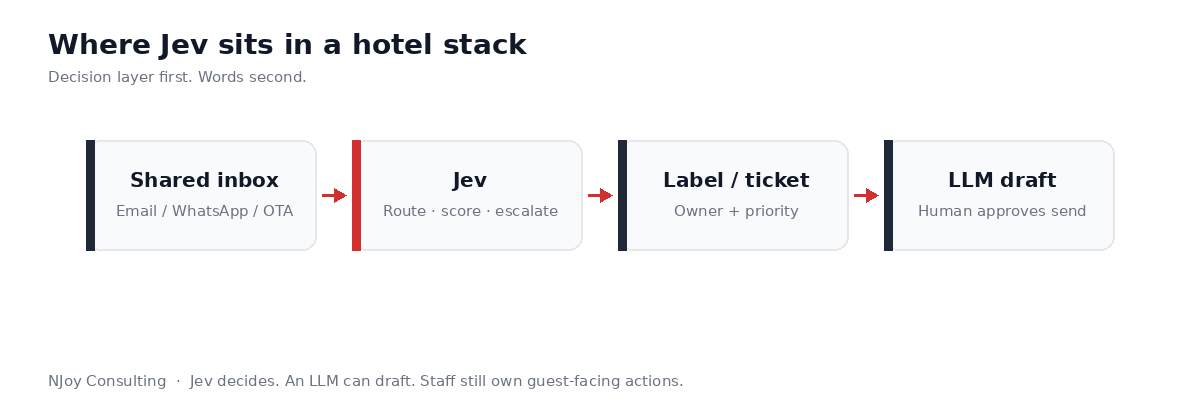
The practical pattern is often Jev plus an LLM, not Jev versus an LLM. Jev can decide the route, priority and escalation requirement; an LLM can then draft the response; a person can approve sensitive or low-confidence cases.
Technical readers often ask why not just use GPT with structured output. You can force a schema that way, but you still get a generative model guessing inside a template. Jev is built for the opposite job: a short input, a closed set of answers, and a probability over each one. That is the difference between formatting words and making a bounded decision your code can gate on.
Where Jev sits in a hotel stack
Keep the flow boring on purpose: observe the shared inbox, let Jev choose the route and priority, write a label or ticket, then draft with an LLM if you want words. Staff still approve anything guest-facing.
What is proven so far?
Jev is very new. As of 19 September 2026, NJoy Consulting could not find a publicly verifiable, named hotel or tourism company saying it uses Jev in production. The public examples around the launch include use cases such as email triage and flight-search decisions, but those are not the same as a documented hospitality deployment.
That does not make the idea irrelevant. It means the responsible next step is a small shadow-mode pilot: let Jev make decisions alongside the existing team, measure them against human decisions, and do not automate customer-facing actions until the error rate and confidence thresholds are understood.
Real tourism companies using adjacent AI workflows
The companies below are useful evidence that classification, automation and AI-assisted communication already solve real hospitality problems. They are not presented as Jev customers. The figures are company or vendor-reported and should be read in that context.
- HBX Group: its Google Cloud case study says service requests are classified by category and sentiment, with more than 30% of repetitive cases in scope for autonomous handling.
- Holiday Inn Express & Suites Orlando at SeaWorld: Canary reports that automated messaging handled 82% of guest communication.
- The Chandler Hotel: this 14-room property is a particularly relevant small-hotel example. Akia reports 90% of guest messages resolved and $30,000 in upsell revenue.
- Tour Partner Group: an STX Next case study describes classification, data extraction and suggested replies, reducing a proof-of-concept task from 30 minutes to 15 seconds.
The lesson is not that every tourism business needs a chatbot. It is that repetitive decisions already sit inside real workflows, and a focused decision model could make those workflows easier to test and control.
Three live Jev tests from NJoy Consulting
We began with three exploratory tourism messages, then expanded the hotel routing test to 100 separately evaluated synthetic enquiries via an AI gateway using typesafe-ai/jev. The routing benchmark used 53,976 tokens; the three exploratory calls used another 2,125.
Test 1: 100 hotel inbox routing decisions
We prepared 100 synthetic hotel enquiries with labels assigned before Jev saw them. The final set contained 50 reservations messages, 42 reception messages, four concierge messages and four manager-escalation messages. Each request asked Jev to choose the team that should own the initial response.
Jev matched the pre-assigned label on 100 of 100 messages. Mean top-label confidence was 99.8%, every result was above the 75% confidence threshold, and median measured latency was 367 milliseconds. Performance was inconsistent at the tail: p95 latency was 29,461 ms (about 29.5 seconds), the slowest request took 101,221 ms (about 101 seconds), nine calls took more than five seconds and six took more than twenty seconds. Those outliers may reflect the gateway or early-access infrastructure, but they would need investigating before production use. The run consumed 48,684 input tokens and 5,292 output tokens.

Examples of messages Jev actually checked
| Channel | Guest message | Jev route | Confidence |
|---|---|---|---|
| Move our booking from 12 October to 14 October and confirm whether the same room rate is available. | Reservations | 100% | |
| Can we change from one double room to two twin rooms for three nights next month? | Reservations | 100% | |
| OTA inbox | Our group needs eight rooms for a wedding weekend. Who can confirm availability and a group price? | Reservations | 100% |
| Web form | Our train arrives after midnight. Please confirm somebody can let us in for late check-in. | Reception | 100% |
| Can we leave two suitcases at reception from 9am before our room is ready? | Reception | 100% | |
| OTA inbox | The air conditioning in room 17 is not cooling. Could someone check it while we are at dinner? | Reception | 100% |
| Could you arrange an airport pickup for two people landing at 18.40 on Friday? | Concierge | 99% | |
| OTA inbox | A staff member entered our room without knocking while we were changing. We want the duty manager now. | Manager | 99% |
Harder cases the clean 100/100 set did not stress
These three messages are illustrative near-misses. They were not part of the scored 100-message run. They show the bilingual, multi-intent and vague traffic a real hotel inbox throws at any router.
| Why it is hard | Example message | Likely split |
|---|---|---|
| Bilingual + two intents | Hola, podemos cambiar la reserva al 18 y tambien necesitamos late check-out el domingo? | Reservations vs reception |
| Vague complaint | Not happy with how last night went. Can someone sort this please. | Reception vs manager |
| Multi-intent pre-arrival | Landing 22:10, need a taxi, and is the room ready early if we pay? | Concierge vs reception vs reservations |
The complete download contains the exact text, source channel, expected route, returned route and probability distribution for every evaluated message.
What this tells us: the integration handled these clear routing categories consistently. It does not prove 100% real-world accuracy. The dataset used ten deliberately clear scenarios with wording variations and became unbalanced when the run was shortened from 200 to 100 requests. A credible hotel pilot should repeat the evaluation on 100 to 500 anonymised emails labelled independently by staff.
Hard requirement for tourism pilots: multilingual coverage is not optional. Guest traffic mixes English with Spanish, French, German, Italian, Portuguese, Arabic, Chinese and local languages. If your test set is English-only, you are not ready to automate routing. Build the labelled set in the languages your property actually receives, and fail the pilot if those cases are missing.
Test 2: a disrupted island tour
The fictional operator reports that rough seas have cancelled the morning boat, 18 guests are waiting, and staff need to arrange alternatives and decide whether management should be involved.
Jev routed the case to operations at 99%, scored urgency at 2 out of 3 with 100%, identified a service failure at 96%, and recommended manager escalation at 88%.
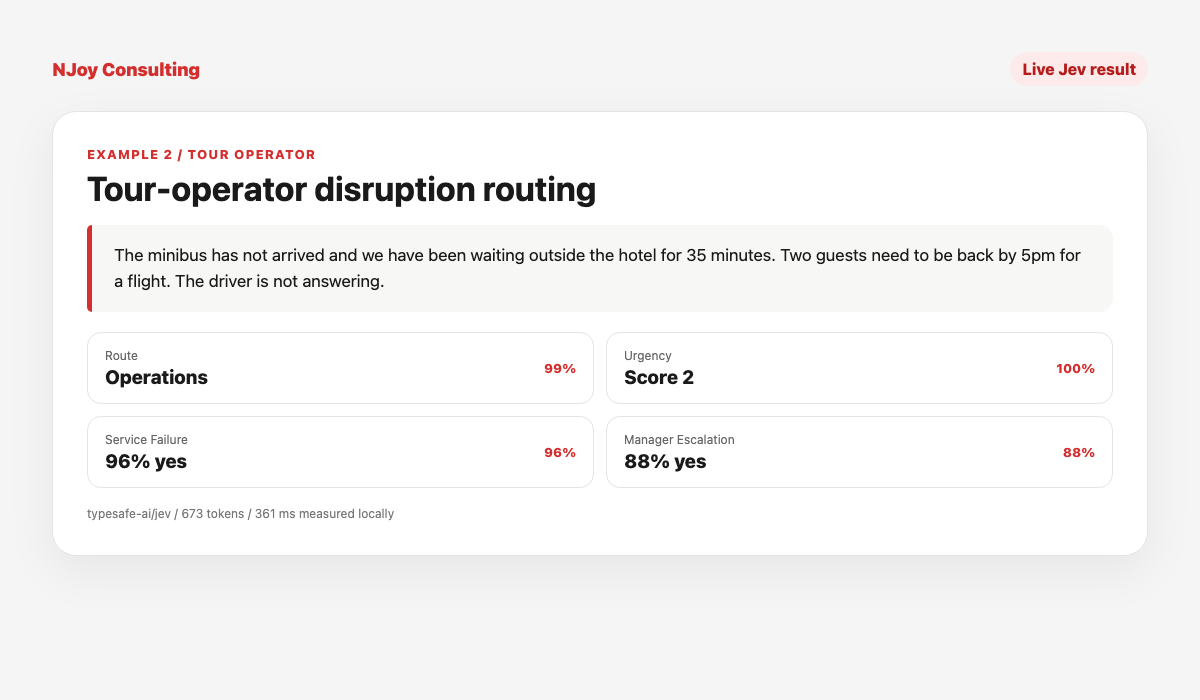
What this tells us: this is a much clearer operational case than the hotel request. The result could safely help sort an inbox or create a priority ticket, but compensation, safety and cancellation decisions should still follow written policy and human authority.
Test 3: a negative guest review
The fictional review says the room was clean, but complains about noise and a front-desk promise that was not followed up.
Jev selected communication as the primary issue at 68%, with noise at 32%. It produced a recovery-priority score of 1.87, recommended a public response at 63%, and recommended direct follow-up at 81%.
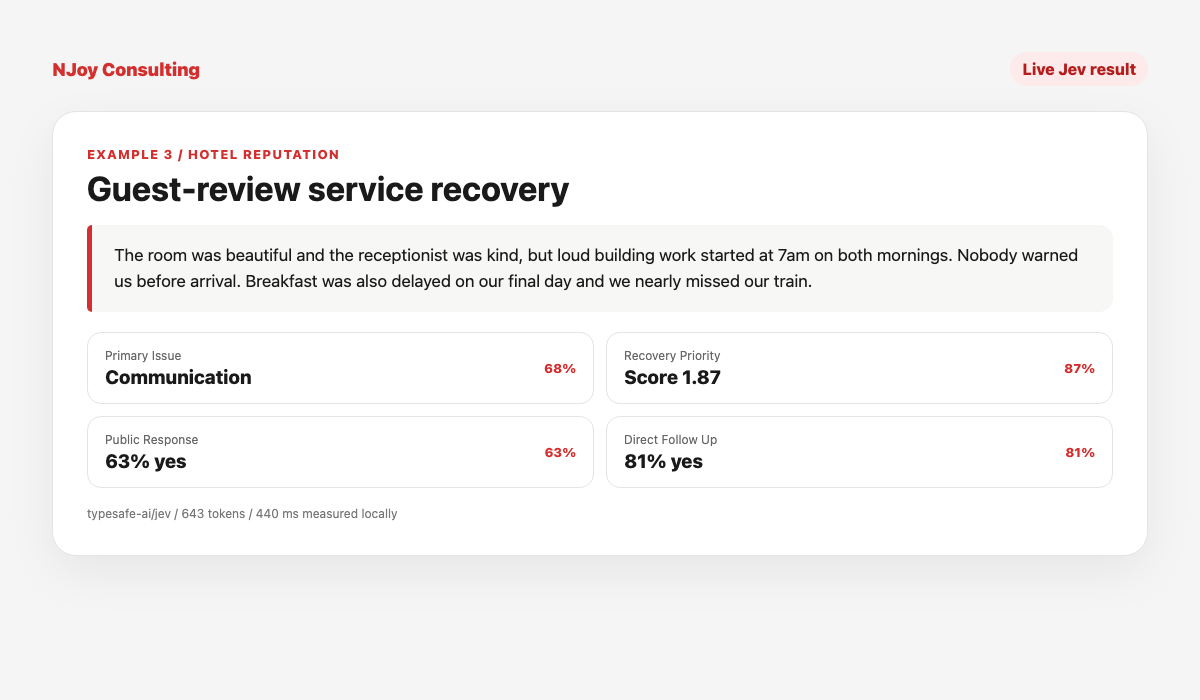
What this tells us: review themes often overlap. A decision model can make the uncertainty visible, allowing a hotel to prioritise follow-up without pretending the review has only one cause.
Methodology
The downloadable JSON is the full record. The points below are the minimum needed to treat the 100-message check as a reproducible mini-study rather than a demonstration slide.
- Model and gateway:
typesafe-ai/jevvia an AI gateway (OpenRouter-compatible requests in our runner). - Test date: 19-20 September 2026 (
generatedAtin the JSON: 2026-09-20T15:31:03.038Z). - Request pattern: sequential calls (not a concurrent load test).
- Latency: wall-clock elapsed time per request as recorded by the runner, including gateway overhead.
- Scenarios vs wording: a small set of underlying hotel scenarios expanded into 100 wording variants; final labelled mix was reservations 50, reception 42, concierge 4, manager 4.
- Labels: assigned by NJoy Consulting before model evaluation. The model did not receive the expected labels or few-shot answer keys in the request payload.
- Retries and timeouts: no automatic retry loop in the recorded run; failed or slow gateway responses remain in the latency distribution.
- Correctness: exact match between Jev’s top route and the pre-assigned label.
- 75% threshold: used as a practical high-confidence gate for whether a result would auto-route or fall back to human review in a pilot design. Every message in this set cleared it; that does not prove the threshold is optimal.
Where could tourism businesses use Jev?
- Shared-inbox triage: route guest messages and flag anything urgent, sensitive or low-confidence.
- Complaint and recovery queues: score severity, identify the likely issue and decide whether a manager should review it.
- Enquiry qualification: classify group, wedding, corporate and leisure leads without asking a generative model to invent CRM fields.
- Tour disruption handling: prioritise weather, transport and supplier issues, while policy and safety rules remain in code.
- Pre-arrival opportunities: identify likely transfers, upgrades, late check-outs or activity enquiries for a person to verify.
- Review operations: sort reviews by topic and recovery priority before an LLM drafts a response.
- Tourism-board enquiries: route visitor, trade, press and accessibility requests to the right team.
For a small hotel, the strongest first project is usually not a public chatbot. It is a quiet assistant behind the shared inbox: observe every message, suggest a route and priority, and show confidence without sending anything.
Limits and safeguards
Jev is a decision model, not an oracle. A typed answer can still be wrong. Confidence is useful operational information, not proof of correctness.
- Do not use it to calculate refunds, dates, room availability or legal entitlements. Use deterministic code and source systems for those.
- Do not let a low-confidence result trigger an irreversible guest action.
- Test language, property type and seasonal edge cases against decisions made by your own team.
- Review what personal data is sent, where it is processed, how long it is retained and what your GDPR basis is.
- Keep an audit trail of the input, allowed choices, returned probabilities and final human action.
- Treat current pricing as temporary. Check the live model listing for
typesafe-ai/jevbefore you scale a pilot.
A practical 30-day pilot for a small hotel
- Week 1: agree five to eight permitted routes, three urgency levels and the cases that must always go to a person.
- Week 2: run Jev in shadow mode on historical or safely redacted enquiries. Compare its decisions with the hotel team's labels.
- Week 3: run it beside the live inbox without sending messages or changing bookings. Record accuracy, disagreement and confidence.
- Week 4: automate only the lowest-risk step, such as adding an internal label. Keep confidence thresholds, fallbacks and audit logs.
Success should be measured in operational terms: time to first response, routing accuracy, urgent cases caught, staff corrections and minutes saved. The target is not “use AI”; it is a workflow that is faster without becoming less accountable.
Download the examples
Guide with the 100-message routing test, exploratory examples and pilot plan.Benchmark JSON ↓
All 100 labels, predictions, probabilities, token usage and latency.Exploratory JSON ↓
The hotel, tour disruption and review examples in full.
Frequently asked questions
Is Jev an LLM?
How accurate is Jev for hotel inbox routing?
How is Jev different from an LLM with structured output?
Can Jev replace a hotel chatbot?
Can Jev process multilingual guest messages?
What should happen when Jev has low confidence?
Is Jev free?
typesafe-ai/jev before you run a larger test.Can Jev be wrong?
Is Jev ready for production hotel automation?
Is any named hotel publicly using Jev?
Could this remove the morning inbox bottleneck?
NJoy Consulting can map a small hotel or tour operator workflow, run a controlled shadow test and give you an evidence-based go-or-no-go recommendation.
Discuss a small Jev pilot